Thursday, April 7, 2011

"Transmission Losses" - The Cost of Bio-fuels

The Times has story of the consequences of crop production for bio-fuels: higher food prices and tragic irony.
...last year, 98 percent of cassava chips exported from Thailand, the world’s largest cassava exporter, went to just one place and almost all for one purpose: to China to make biofuel.
...It can be tricky predicting how new demand from the biofuel sector will affect the supply and price of food. Sometimes, as with corn or cassava, direct competition between purchasers drives up the prices of biofuel ingredients. In other instances, shortages and price inflation occur because farmers who formerly grew crops like vegetables for consumption plant different crops that can be used for fuel.

China learned this the hard way nearly a decade ago when it set out to make bioethanol from corn, only to discover that the plan caused alarming shortages and a rise in food prices. In 2007 the government banned the use of grains to make biofuel. [emphasis added.] ...Although a mainstay of diets in much of Africa, cassava is not central to Asian diets...

“For Americans it may mean a few extra cents for a box of cereal,” she said. “But that kind of increase puts corn out of the range of impoverished people.”

Higher prices also mean that groups like the World Food Program can buy less food to feed the world’s hungry.

[Source: NY Times]

Wednesday, March 30, 2011

Public Transit or Private Cars, It's All About the Fuel

[The following is an article I wrote in Earth Island Journal last year to answer the question "Public Transit or Electric Car?." ]

Greater support for mass transit and appropriate land use policies that make mass transit accessible are essential. They are essential for more livable communities and more efficient use of resources, including energy. However, we have created a nation that is dependent, for the foreseeable future, upon the automobile. And many of the rest of the world’s inhabitants aspire to automobile ownership. China has opened up high-speed rail lines while the United States fiddles. Yet simultaneously, China has overtaken the United States in the number of automobiles sold annually.

ChargePoint-CityofSF_BW.jpgCity of San FranciscoSan Francisco recently became the first city in the country to mandate plug-in charging stations
for all new buildings.

Despite billions of dollars of investment, in most of the United States only a tiny percentage of people use mass transit regularly. The latest report by the American Public Transportation Association documents a 3.8 percent decline in ridership overall in the first nine months of 2009. Designing our cities and regions around mass transit is something we must do, but it is a multi-generational project.

In other developed countries – in Europe and Asia, for example – clean, electric public transit is the principal means of transportation. In most of the developing world, public transit remains the only viable means of getting around. But the commuters in poorer nations usually travel in a haze of pollution created by petroleum-powered trains and buses. The basic problem that faces transportation today isn’t whether people travel on mass transit or in automobiles, but rather the technology and fuel employed.

The question that faces us is how to ensure that our mass transit and private cars minimize the negative environmental impacts of travel. To do that we must set our nation, and the world, on a path to eliminate petroleum as the predominant fuel for transportation. To continue to rely on petroleum is to accept as inevitable the immense political power of the world’s wealthiest corporations and the resultant pollution, climate change, and war. There is no catalytic converter that can fully scrub the toxics that result from burning oil. And there is no way to democratize the production and distribution of petroleum.

There is, however, an alternative path: Electricity. It’s been around a long time and powers just about everything we use except transportation. It’s ubiquitous, relatively price stable due to government regulation, and is created in many ways, increasingly including renewable – such as solar, wind and geothermal – sources.

Of course we need energy to create electricity, and just as we’ve been burning petroleum for a century to move us and our stuff around, we’ve been burning oil and coal and natural gas to create electricity. While burning all those fuels has caused pollution just as surely as gasoline cars and trucks, we have options. As aging, filthy coal power stations are retired, they are often replaced with cleaner-burning natural gas generators. And now we are making a commitment to renewable electricity generation. Multiple sources of electricity generation make the grid reliable. In contrast, there is no effort to protect our transportation “grid” from vulnerabilities to petroleum’s monopoly.

While our electricity generation is becoming cleaner and more renewable due to state and federal mandates, switching to electricity for transportation immediately lowers emissions. On the existing US electric grid, half of which is powered by dirty coal, an electric car already is less polluting and emits fewer greenhouse gases than the average gasoline car. In the worst cases, like some nearly 100 percent-coal-powered states, the emissions profiles may be a wash. In others, like California and Texas, which use a preponderance of natural gas, it’s truly a slam dunk for electric transportation. Given our commitment to ever more solar, wind, and other renewables, electric transportation will only get cleaner.

Only with an electric car could you aspire not only to zero-emission driving, but to making your own zero-emission electricity to feed it. Putting solar PV panels on one’s roof is not rocket science, nor out of reach for millions of homeowners. With renewable power and plug-in cars, we can begin to get control over our energy destiny.

A central goal of the twenty-first century must be to bring the revolution of electrification to transportation – and that will include both mass transit and personal vehicles.

Saturday, March 19, 2011

Transmission Losses: 100 mile oil slick in Gulf

The Coast Guard is investigating reports of a potentially large oil slick in the Gulf of Mexico not far from the Deepwater Horizon site. According to a knowledgeable source, the slick was sighted by a helicopter pilot on Friday and is about 100 miles long. A fishing boat captain said he went through the slick yesterday and it was strong enough to make his eyes burn.
[Source: Huffington Post]

Automakers continue to face challenges caused by quake

  • Nissan may have to ship engines from Tennessee to Japan.
  • Honda is extending the shut down at its shuttered plants.
  • Worries about Prius supply has already increased the average price by the consumer by $1,800.
  • GM and Nissan production in the US is being disrupted by lack of Japanese parts.

[Source: NYTimes]

Monday, March 7, 2011

PlugShare creates guerilla network to charge electric cars

For years we've been hearing there's a chicken/egg situation with EVs. Consumers, it's often suggested, have rejected plug-in cars because there is no charging infrastructure. No, I've always said, we have a chicken problem. No plug-in cars. The infrastructure, ubiquitous electricity, exists.

Volts and LEAFs are being slowly delivered, but the public charge station rollout paid for by the feds is coming even more slowly, especially in places getting early vehicle allocations. And those that do exist are often encumbered by restrictions and fees.

PlugShare launches today, just in time. Radical democracy for plug-in cars. One doesn't even need an EV to participate. Strike a blow against Big Oil by letting cars plug in at your place.

Stories today in the SF Chronicle and NY Times.


Thursday, March 3, 2011

The trials of public charging, part 2 (of many to come)

I wrote back in December about my unhappy experience attempting to charge my loaner LEAF at San Francisco City Hall's electric car charging stations. Parking in these Coulomb charge stations is restricted to city-owned vehicles and Car Share companies under threat of towing. A threat taken seriously in San Francisco.

I wrangled a few hours of charging back in December from Bob Hayden, the SF Department of the Environment's EV Czar. And I wrangled time again while Tom Dowling and I met more recently with Bob at the SFDOE (this time to charge my own, recently delivered LEAF.)

But one shouldn't have to know Bob to plug in your new car. It's city, state and federal policy to enable electric cars for the emissions and petroleum reduction they provide. I'd hoped the City would find a way to open up the opportunity for the people beginning to obtain plug-in cars to more freely use these rare, public charge stations. Publicly plugging in is an act of coming out, of civic responsibility. Plugging in to public charge stations is part of the process of introducing Americans to electric cars.

Unfortunately there are still damn few J-plugs (the new standard for plug-in cars) publicly deployed, despite the expectations created by the federal grants to the EVProject (Ecotality) and ChargePoint America (Coulomb) and ex-Mayor Newsom here in San Francisco. The situation is similarly bleak in Southern California. And the fact is that the cars, however slowly, are being delivered. San Francisco's Department of the Environment just received its first LEAF, which now uses one of these spaces. It sits over the weekend, long since fully charged, demonstrating the city's greenness, I suppose, while preventing anyone from using the charge station. Making one spot available over the weekend would be one way to demonstrate a commitment to public access to this publicly funded infrastructure.

Here in San Francisco there are three sites (6 J-plugs) listed on Coulomb's/ChargePoint America's/MyChargePoint.net website, including the three at City Hall. At one you pay for parking and for plugging in, one is free, and one is restricted. In fact, there is another pair of J-plugs I know of in the Hilton's garage on Kearny St., but since they aren't Coulomb product, they aren't listed. Problem #1, Who's going to aggregate this information to be useful for drivers?

Problem #2: It needs to be noted (especially by new drivers) that the electrons don't just flow from many of these public J-plugs when you plug into the car as they do for the previous generation - EV1s and RAV4 EVs. They need to be activated with a phone call, a Coulomb card (one-time $10 per card), or in some cases a credit card. For a while, the electricity will be free with a phone call or Coulomb card, but eventually - probably sooner rather than later - there will be a cost to charge at many charge stations.

There is a cost to charging. Take that every way it can be taken. What I want to focus on is the unintended consequences of near-term monetization of public charging. Only half the story about public charging is providing juice: enabling drivers to extend the range of their vehicles beyond their night-time "fill-up" at home when necessary and overcoming newbie "range anxiety." The other half, for the next five years or so, is outreach and education. An opportunity to demonstrate to the 99+% who have no experience with plug-in cars that the cars are real. "There one is," says Mr. Jones to Mrs. Jones as they walk pass one plugged in at the shopping mall. And if the Joneses ever wondered about electric cars, they just might get to ask the owner some questions.

Monetize that charge station during the first few years the cars are appearing, and we lose 90% of the opportunities to talk with Mr. and Mrs. Jones. Here's what's going to happen: You get your new LEAF or Volt. A charge station appears at the grocery store you frequent. You plug it in, but nothing happens. You see the credit card symbols. If you happen to have a chip-enabled credit card (I have no idea how prevalent they are), you wave it. Juice flows. A small crowd gathers. You answer questions about the car. This is exciting. But after getting the monthly bill, you decide to forgo the recurring $2 charge for 50 cents of electricity you didn't need anyway. And maybe you'd begun to tire just a little of the attention.

Now that your new plug-in car is parked discretely with the gas burners, what happens to the charge station? It waits patiently for someone to really need it. And everyone entering the store passes the empty space, the "charger" standing sentry inconveniencing the "real" cars while suggesting government waste on another failed project.

Near-term monetization also threatens needed expansion of charging infrastructure, as the early installations become underutilized. It is already ironic enough that the two companies pushing monetization as the necessary component for a successful rollout of public charging infrastructure have taken the lion’s share of the public funding in order to develop their “free market” solution. It would be doubly ironic if low usage caused by early monetization resulted in insignificant amounts of revenue suggesting a poorer profitability picture than projected creating an impediment to necessary further expansion of both public charging stations and their own business.


The federal funding should have come with strings attached. For a certain period, say two to five years, the electricity should just flow. No connecting to a network, no payment. The host - the city parking garage or shopping mall - would agree to cover the cost of electricity in exchange for the charging unit and all the green cred and good will they can muster. After a few years, with lots of experience, let the hosts decide if they want to monetize. At that point hopefully there will be enough plug-in cars around that they will no longer be a novelty needing explaining, and we will actually want to discourage purely opportunistic public charging to ensure their availability when someone really needs the juice. At that point, we'll all be willing to pay.


But if PlugShare catches on, we may not have to.


"Transmission" Losses: Billion Dollar Fuel Theft

After nearly a decade of mismanagement, theft and fraud, the U.S. military still hasn't found a way to staunch the flow of what is likely hundreds of millions -- if not billions -- of dollars in lost fuel in Afghanistan, some of which is sold on the black market and winds up in Taliban hands, a TPM investigation has found.
[Source: TalkingPointsMemo.com]

Saturday, February 26, 2011

The electricity in gasoline

I just ran across the latest available data, from 2007, for the electricity consumption by petroleum refineries. The US is, hoorah, #1. Over 49,000,000,000 kWh.

One electric car, roughly speaking, will use about 3000 kWh to go about 12,000 miles.

That means the electricity alone we use to refine petroleum each year could drive over 16,000,000 electric cars 12,000 miles each year.

And that doesn't include the electricity used in oil extraction and pumping.

[Source: Energy Statistics Database | United Nations Statistics Division under "Total Electricity" then "Consumption by petroleum refineries"]

Thursday, February 3, 2011

iMiev #1 in Norway

Norway's EV enthusiast site Electricaid reports that iMiev is #1 in Norway. In its small car segment in January, the little electric outsold each of its gasoline competitors. 99 iMievs sold.

[Source: Electricaid]

Wednesday, January 26, 2011

"When money flows from the ocean floor"

In January 2007 it was reported from Davos that Shimon Peres was in talks to bring an electric car factory to Israel. I wrote:
It's about time. If there's one country that ought to have long ago developed a domestic electric car industry it is Israel. No oil of its own should be reason enough. Every drop purchased on the international markets propping up its sworn enemies should be reason enough. Not very far to drive in this very small country should be reason enough. Lots of high tech brainpower should be reason enough. Dayenu.
The beginnings of Better Place, of course. Also, one could hope, the beginning of the transformation of Israel from a vulnerable fossil-fuel deficient and dependent nation into a 21st century renewable energy beacon.

Now it seems the discovery of natural gas off the coast may have moved Israel's eye off the prize.
"The beautiful vision evaporated in the bureaucratic grinders, and the prime minister fell into the very trap against which he had warned. When money flows from the ocean floor, who has time to think about correcting the world?"
Read the interesting tale here.

[Source: Ha'aretz]

Obama rolls out EV strategy

At EnerDel's Indiana battery plant today, VP Biden outlined the administration's EV strategy. The Obama administration is calling for raising the number of plug-ins that qualify for federal incentives from 200,000 to 500,000 cars per manufacturer. In addition, Obama is looking to convert the federal tax credit into a rebate available at the time of sale. More here.

[Source: Detroit News]

Thursday, January 20, 2011

Mercedes Pleads for More Handouts for Hydrogen

While governments scrape together money to roll out a public charging infrastructure for the plug-in cars that are already being delivered to customers, Mercedes is pleading for more money to enable hydrogen fuel cell vehicles they have failed to deliver for a decade.

[Source: AutoBlogGreen]

Monday, January 3, 2011

LEAFs arriving by the truckload

LEAFs are beginning to arrive by the truckload. Seven drove in to a SoCal dealership this morning.

Tuesday, December 28, 2010

EV Ownership Shortcut?

Here's an unexpected opportunity to purchase an EV, especially if you've had a hankering for a Th!nk City.

According to the Seattle Clean Cities Newsletter, you've got three days to order a Th!nk City for $6000 off from the base price of $41,695 if you live in a ZEV state. Th!nk is apparently looking to quickly sell 150 of the vehicles they are putting together in Elkhart, IN. Offer ends December 31.

Add in the federal tax credit, and the electric two-seater is down to around $28,000. If they can deliver quickly enough to California, a rebate of $4000 - 5000 should kick in as well.

That's obviously less car for about the price of a Nissan LEAF. But if you haven't ordered one yet, there could be quite a wait.

Wednesday, December 22, 2010

Proud Papa

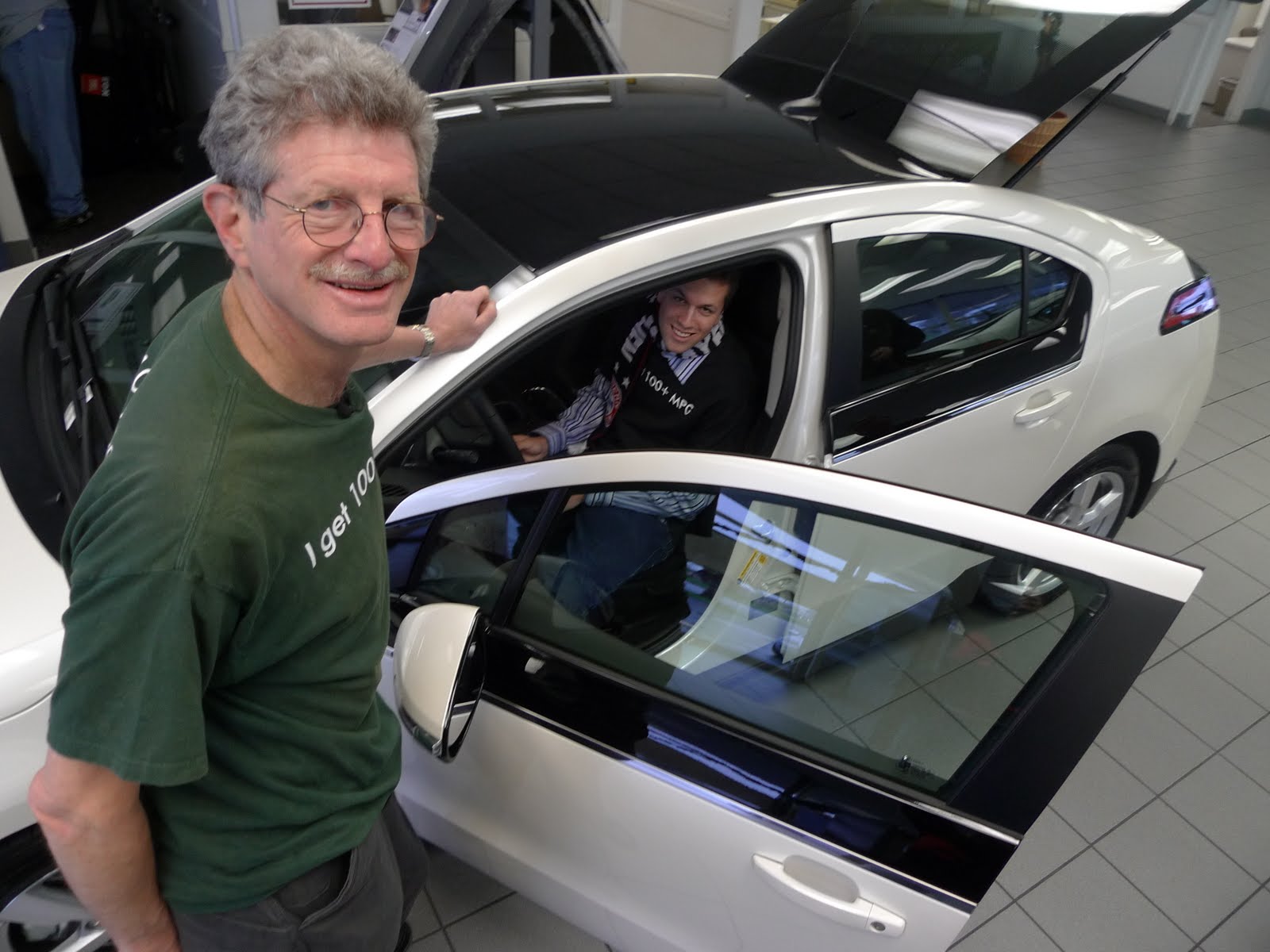
Felix Kramer, indefatigable campaigner for plug-in cars, took possession today of his Chevrolet Volt at Novato Chevrolet. Here he is, with his son Josh in the driver's seat.


Andy Frank, father of the plug-in hybrid, drove down from Davis, California in the Volt he received yesterday to join in the celebration.

Wednesday, December 15, 2010

My Trial LEAF & the trials of public charging


I've got a LEAF for a few days. Very exciting. I'll have a full report soon. But I've got to mention one frustration I've encountered. Restricted charge stations.

In San Francisco at this moment there are, I believe, six deployed new J1772 charge stations. One, a ParkPod unit in the Hilton parking lot, was installed with private funds. Two are at a private parking garage on the Embarcadero, paid for with federal and state money via Coulomb's ChargePointAmerica grants. And three streetside at City Hall, trumpeted in signage as a "Green Vehicle Showcase."

Usage at the City Hall location is restricted; only official city and ZipCar plug-in vehicles may use them. All others subject to ticketing and towing.

Ironically, in practice this means only the converted plug-in Priuses in government and ZipCar fleets, using the 120 Volt receptacle in these Coulomb ChargePoint stations, can park and charge. The LEAF I've got for a few days, which could plug in at Level 2 and be showcased, remains underground out of site while I sit on a jury a block away. And I could use the charge, as I'm charging at 120 volts at home. And, adding insult to injury, two of the three spaces with chargepoints were open when I went to court, during lunch, and when I departed. The third, occupied by a BAAQMD plug-in Prius, appears not to have gone anywhere, long ago charged to full.

The point isn't my convenience while doing jury duty. Ordinarily, I'd take the bus. It's about optimally utilizing the public investment in charging infrastructure. San Francisco spent tens of thousands of dollars installing these charge stations. Mayor Newsom trumpeted their arrival, and Coulomb uses them in its self-promotion. They are serving everyone's interest save the public.

The day has finally arrived when they could be used as intended, for opportunity charging and to showcase the arrival of electric vehicles. Bureaucratic obstacles must be overcome, at least during the first year or two, to maximize the public benefit of this investment. Empty spots and/or restricted access does not serve the interest of the drivers, nor in reality, of the infrastructure providers or government trying to educate the public about electric vehicles.

Saturday, December 11, 2010

First LEAF delivered in Petaluma California

Olivier Chalouhi, owner of the first LEAF sold in the world with Carlos Tavares, Nissan Executive Vice President for the America.


Olivier at the wheel driving off to the Nissan event in San Francisco Civic Center.


Caravan of LEAFs headed to SF as seen from my RAV4 EV.


Olivier surrounded by the media outside SF City Hall.


Crowd gathered in SF Civic Center.


Check out Nick Chambers' report in plugincars.com

Wednesday, December 8, 2010

Help Plug In America renew the EV infrastructure tax credit

From Plug In America:

Last year, Plug In America, along with electric vehicle and EV infrastructure manufacturers from coast to coast, worked with members of the House and Senate to get a critical plug-in vehicle infrastructure tax credit into the stimulus bill.

And then you helped us get it passed!

These EV tax credits of 50% up to $2,000 for individuals, and 50% up to $50,000 for businesses have led to the beginning of early deployment of EV charging infrastructure all across the United States.

But the infrastructure tax credit is set to expire on 12/31/2010 unless we act now!

Just as plug-in cars are about to get on the road is absolutely the wrong time to end these tax credits.

We were initially successful in advocating for an extension in the proposed 2010 tax extenders legislation. But now our efforts are threatened - we hear that the tax credit extension for EV infrastructure may be scaled back or eliminated from the tax extenders bill. This credit should be extended at the same level as in the stimulus for at least another three years.

We need your help - and we will do most of the work. Please take just a moment to click through the link below and send a strong message to your representatives in Congress and the President telling them that you want plug-in electric vehicles to be successful along with the truly green jobs they can create. Show Washington just how serious you are about wanting to make sure we can get affordable plug-in infrastructure at our homes and businesses and support plug-in vehicles getting on the road now.

It is time to ask Congress to advance the next generation of transportation options. Each and every voice they hear will make a difference.

Let us do the work for you - Just click the link below and in less than a minute you can get your message to Congress about this key issue:

Click here to tell Congress you want these tax credits extended

Thank you!

Jay Friedland
Legislative Director
Plug In America

P.S. If you are about to purchase a new plug-in vehicle, you may want to purchase your EV charging station before the end of the year just in case!

Wednesday, November 24, 2010

Ethanol Gets Teabagged

Senators Coburn and DeMint have corn ethanol subsidies in their sights. The environmental case rests on a thin reed indeed. I'm hoping they succeed. Firedoglake has the story.

UPDATE: California Senator Dianne Feinstein is on board will letting the subsidies expire on December 31, 2010.

[Source: Washington Post]