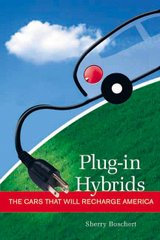
Stefano Paris, plug-in car and renewable energy supporter and renaissance man, has made a video of Plug In America's rally in Sacramento outside CARB last month. Check out the video, and his extremely useful website on plug-ins here.
Saturday, April 19, 2008


Friday, April 11, 2008
LA Times: CARB's Sperling Conflicted
Check out today's LA Times piece by Ken Bensinger on CARB Board Member Dan Sperling, here.
The UC Davis Institute he heads took in millions from auto and oil companies in the years prior to his appointment by Gov Schwarzenegger. At last month's Board Meet, Sperling spearheaded a proposal to cut the number of zero emission vehicles required by the ZEV program. Spirling has been a major proponent, along with the automakers and oil companies, of shifting the program's emphasis from near-term battery electric cars to decades-away hydrogen fuel cell vehicles. A one-time supporter of electric cars, he says in the article,
The UC Davis Institute he heads took in millions from auto and oil companies in the years prior to his appointment by Gov Schwarzenegger. At last month's Board Meet, Sperling spearheaded a proposal to cut the number of zero emission vehicles required by the ZEV program. Spirling has been a major proponent, along with the automakers and oil companies, of shifting the program's emphasis from near-term battery electric cars to decades-away hydrogen fuel cell vehicles. A one-time supporter of electric cars, he says in the article,
"I lost funding [for the institute] from the Detroit car companies for many years, and I realized I should not be taking those policy positions unless it was really well-grounded," he said.
Monday, April 7, 2008
Luxurious greenwashing, Lexus-style
Check out my snarky AutoblogGreen.com post on Lexus' greenwashing. Quoting myself,
Lexus is taking hybrid hype to the next level, the penthouse.....At one time Toyota was content to let the Prius subliminally lower consumers' green expectations from electric cars to hybrids which use gasoline-generated electricity to raise efficiency. Lexus has gone literal - "h" is the new green lifestyle. Instead of actually manufacturing and marketing the greenest vehicles Toyota has already proven they could produce....
Saturday, April 5, 2008
Is NRDC drinking the hydrogen kool-aid?
 The following guest blog post is by Earl Killian who often blogs at Joe Romm's ClimateProgress.org . Biographical information below the post.
Is NRDC drinking the hydrogen kool-aid?
Imagine for a moment that the world had rejected wind and solar energy, and instead decided to wait for a hydrogen fusion research program to reach fruition. Where would we be today? Fortunately for the world, wind and solar are growing rapidly, while hydrogen fusion research remains speculative at best. But when it comes to cars, the hydrogen kool-aid seems to be working and putting research before solutions.
Roland Hwang is an NRDC policy analyst working on transportation energy issues. In his blog he writes:
Originally conceived of in 1990, the California ZEV program has morphed over time from just an electric car mandate to incorporate a broad spectrum of clean, advanced technology vehicles, such as hybrids. 2008 required another tune up based on the opinion of the Air Board’s own independent technology review panel which said that fuel cells cars are not ready for mass commercialization.
There’s a contradiction in those two sentences. If the ZEV program is a “broad spectrum of clean, advanced technology vehicles,” then why does it need a “tune up” because “fuel cell cars are not ready for mass commercialization”? The answer is that the ZEV program has in reality bcome a hydrogen fuel cell research program, apparently even in the mind of the NRDC. And to make his point Hwang stretched the original goal of 8,333 ZEVs per year into “mass commercialization.” Hwang went on to write,
That is, they reduced the fuel cell requirement by 17,500 cars, but strengthened the program by requiring 58,000 plug-in hybrids.
That sounds good, but he never discusses the possibility, so often found in the pre-meeting comments submitted, of getting the plug-in hybrid numbers by taking the dirtiest cars off the road instead of the cleanest ones. At the very least, CARB could have converted their hybrid requirements into a plug-in hybrid requirement, instead of taking from the small ZEV numbers.
Hwang also never considers whether CARB is leading or following the market on plug-in hybrids. If it is following, then it is simply giving the automakers credit for something that plan to do otherwise.
CARB’s reduction in ZEV deployment guarantees that the automakers will spin the tiny number of ZEVs now required as being “uneconomic”. By the estimates presented at the meeting, 1,667 additional vehicles per year will cost the automakers and additional $147 million, so they expect them to lose $88,200 per FCV. BEVs in contrast could be sold at a profit.
Why does the NRDC ignore Battery Electric Vehicles (BEVs) and pretend that only hydrogen fuel cell vehicles can satisfy a ZEV goal? One would expect the NRDC to understand that hydrogen Fuel Cell Vehicles (FCVs), even if the research someday reaches fruition (fuel cells have both lifetime and cost issues in the foreseeable future), make it two to four times harder to solve our greenhouse gas emissions problem, and can do so only by using up unnecessary wildlife habitat.
If the hydrogen for FCVs comes from steam reformation of methane (11,888 g CO2e/kgH2), then greenhouse gas emissions per mile for a 50 mi/kgH2 vehicle are 238 g/mi. The 2008 Toyota Prius is 242 g/mi today. If FCVs are to be better than a Prius, the hydrogen must be produced from renewable energy.
California’s own Hydrogen Highway Blueprint Plan estimates that hydrogen FCVs will require more than 4000 BTU/mi (1172 Watt hours per mile) of renewable energy. Even a boxy SUV built with decade old technology (the Toyota RAV4-EV) uses only 302 Wh/mi, according to the EPA’s Fuel Economy website. If powered by renewable wind and solar, extra Watt hours translate into extra land use for solar and wind farms. FCVs will therefore be wasteful of land and our renewable electricity investments. But FCVs are still in research, and perhaps the final result will be more efficient than California’s blueprint allows? Let us look at what might be possible if FCVs achieve all of the aggressive goals set for them.
Because a FCV is essentially a BEV where some (but not all) of the batteries/capacitors have been replaced by a hydrogen tank and a fuel cell, and the plug is optional (but probably desirable), it is straightforward to compare the vehicles. Use an identical 260 Wh/mi for motor to wheels efficiency. For a BEV, this gives 300 Wh/mi at the garage plug (as seen on the RAV4-EV). The DOE’s FreedomCar’s goal for fuel cells at their peak efficiency is 20kWh of electrical output per kilogram of hydrogen fed into it. Thus to power the wheels one mile we need 13g of hydrogen (or 77 mi/kg). FreedomCar’s goal is still a ways off (most similar sized FCVs are less than 50 mi/kg). Next, according to NREL, “An efficiency goal for electrolyzers in the future has been reported to be in the 50 kWh/kg range, or a system efficiency of 78%.” Thus 13 g/mi of hydrogen to operate a FCV of the future requires 650 Wh/mi of renewable electricity. This is better than the 1172 Wh/mi in the Hydrogen Highway Blueprint Plan, but still a factor of two higher than the BEV requirement. Wouldn’t this additional land be better used toward solving our electricity greenhouse gas emissions, instead of wasting it on inefficient FCVs?
Earl Killian is a software engineer and microprocessor architect who is also passionate about finding solutions to the global warming crisis confronting us. He graduated from MIT in 1978 (B.S. Electrical Engineering and Computer Science), and has most recently worked for MIPS, QED, SGI, and Tensilica, all silicon valley companies engaged in creating microprocessor products. He was a co-founder and CTO of QED, and held the title Director of Architecture at each of the other companies. His microprocessor work has resulted in 23 patents issued so far. Earl Killian and his wife drive two battery electric vehicles, fueled by sunlight from the photovoltaic panels on their home.
Wednesday, April 2, 2008
CARB's Conflict of Interest
The California Air Resources Board (CARB) and the California Fuel Cell Partnership (CFCP) have become inseparable. The Green California Summit taking place next week in Sacramento appears to provide one more small example.
As I stated in my testimony before CARB's Zero Emission Vehicle Program meeting last week, to understand the conflict of interest
It would be a different matter if this were two government agencies sharing space to save taxpayer money. But this is a government regulatory agency cohabitating with a group dominated by the regulated corporations, including auto manufacturers, energy providers, and fuel cell technology companies.
Ever since Alan Lloyd chaired both CARB and the Fuel Cell Partnership at the time of the disastrous 2003 vote that eviscerated the ZEV Mandate, and perhaps before, something has been fundamentally wrong about the relationship. The mission of CARB's Zero Emission Vehicle program appears to have been corrupted. Once the goal was to bring zero emission vehicles to market, and the result back then was thousands of electric cars on the road. Now CARB is content to shepherd a research program, gambling on technologies - hydrogen and fuel cells - that with every passing day disappear further over the horizon. This relationship jeopardizes achieving California's clean air, carbon and petroleum reduction goals and it is time for the legislature to look into it.
As I stated in my testimony before CARB's Zero Emission Vehicle Program meeting last week, to understand the conflict of interest
one need look no further than the CARB homepage, where hydrogen and fuel cells – not ZEVs - receive prominent placement, with no equivalent recognition of battery electrics. The same members of staff that administer the ZEV program and make recommendations to this Board are charged with promoting and administering the hydrogen highway and fuel cell projects. A bias toward one technology is reflected in the titles and job descriptions of many staffers who wrote the recommendation you are considering today that give a fuel cell vehicle more credit than a battery electric vehicle with the same range.At the upcoming Summit, CARB and the Fuel Cell Partnership share booth #1001. Not in the sense that ZAP and Global Electric are housed at a booth divided into A and B. No. On the floorplan, booth 1001 is simply "CA Fuel Cell Partnership & CA Air Resources Board."
It would be a different matter if this were two government agencies sharing space to save taxpayer money. But this is a government regulatory agency cohabitating with a group dominated by the regulated corporations, including auto manufacturers, energy providers, and fuel cell technology companies.
Ever since Alan Lloyd chaired both CARB and the Fuel Cell Partnership at the time of the disastrous 2003 vote that eviscerated the ZEV Mandate, and perhaps before, something has been fundamentally wrong about the relationship. The mission of CARB's Zero Emission Vehicle program appears to have been corrupted. Once the goal was to bring zero emission vehicles to market, and the result back then was thousands of electric cars on the road. Now CARB is content to shepherd a research program, gambling on technologies - hydrogen and fuel cells - that with every passing day disappear further over the horizon. This relationship jeopardizes achieving California's clean air, carbon and petroleum reduction goals and it is time for the legislature to look into it.
Tesla to sell Roadster in Europe
 Governor Schwarzenegger can expect delivery of his $100,000 electric Tesla Roadster within a few months. His pals in the Old World won't have to wait too much longer before they can buy their own, for a cool €100,000 ($156,000.) The Roadster will be sold in Europe beginning in Summer, 2008, CEO Ze'ev Drori has told the Financial Times.
The upstart California auto maker decided to offer its vehicles in Europe for a number of reasons. Favorable tax treatment of electric cars as well as other incentives are among the measures the continent hopes to employ to lower carbon emissions. The weak dollar also makes Europe an attractive market. Although the chassis and body are made in the U.K., with no plans for a right hand drive version the English rich and royal are out of luck.
Tuesday, April 1, 2008
Sandia Labs Researcher Says Electric Makes More Sense
Sandia Labs Researcher Ben Cipiti has penned a short piece entitled An Unbiased Approach to Evaluating Transportation Fuels in which he extols the virtues of plug-in cars to meet our environmental and national security goals. He correctly identifies the problem bedeviling consumers, policy makers and, perhaps, auto makers.
Many of us want to know what we can do to make a difference. Yet with so much varying information about energy alternatives, it has become difficult to choose which technologies really make sense and which will be a waste of research dollars.He briefly recaps the problems with ethanol and hydrogen and concludes:
Of the alternative transportation options, electric vehicles coupled with increased use of renewables and other clean sources of energy will be the most efficient way to reduce pollution and eliminate dependence on foreign oil. We need to look at all of the issues to concentrate funding on the solutions that make sense.Read the entire article here.
Tuesday, March 25, 2008
Some of the Facts : Automakers Comment to CARB
The Large Volume Manufacturers, the automakers with obligations under the California Air Resources Board (CARB) Zero Emission Vehicle Program, have made a joint comment about the staff proposed revisions that will be voted on Thursday March 27 in Sacramento. It can be seen here (comment #121) along with 187 other public comments (overwhelmingly asking for a stronger mandate for plug-in cars) on the CARB website. Despite the various positions advanced by each automaker independently, they overcame their differences to say they “remain very concerned” that “provisions being proposed by Staff are overly stringent.” The letter states that the Staff recommendation has increased the volume of ZEVs and PHEVs required from 2012-2014 and this would result in additional costs of up to $3.4 billion. An accompanying chart shows the increases.
But the explanation is disingenuous. The chart compares the November 2007 Concept Paper to the February 2008 45-day Notice, which results in a possible increase of 630 zero-emission vehicles. Yes, 630 vehicles over a three year period from 2012 to 2014. What is missing in this presentation is the ZEV Program requirements endorsed by CARB in 2003, the requirements as they stand now. Back then, when the intention was to kill the electric car, automakers signed on to an “alternative path” replacing battery electric vehicles with fuel cell vehicles. An obligation to manufacture a meaningful percentage of electric cars dropped down to a required 250 FCVs by 2008, then 2500 by 2012, and then 25,000 by 2015. But what happened to the 25,000 ZEVs in the automaker’s plea? Absent of course, since including it would make clear that the staff revision in fact lops off 90% of the 2003 ZEV requirement. The automakers bemoan a supposed 25% increase, while ignoring what is actually a 90% reduction.
Chutzpah.
But the explanation is disingenuous. The chart compares the November 2007 Concept Paper to the February 2008 45-day Notice, which results in a possible increase of 630 zero-emission vehicles. Yes, 630 vehicles over a three year period from 2012 to 2014. What is missing in this presentation is the ZEV Program requirements endorsed by CARB in 2003, the requirements as they stand now. Back then, when the intention was to kill the electric car, automakers signed on to an “alternative path” replacing battery electric vehicles with fuel cell vehicles. An obligation to manufacture a meaningful percentage of electric cars dropped down to a required 250 FCVs by 2008, then 2500 by 2012, and then 25,000 by 2015. But what happened to the 25,000 ZEVs in the automaker’s plea? Absent of course, since including it would make clear that the staff revision in fact lops off 90% of the 2003 ZEV requirement. The automakers bemoan a supposed 25% increase, while ignoring what is actually a 90% reduction.
Chutzpah.
Friday, March 21, 2008
Electric Subaru: Tell 'em what you think

Subaru has brought some R1e electric mini-cars to NY. They have a program with Tokyo Electric Power Company that has been testing vehicles in Japan since 2006. Now, they're at the NY Auto Show, and two of them are joining the New York Power Authority fleet. Much like the Th!nk City that NYPA also tested, the cars have a 50 miles range with a 65 mile per hour top speed. Any interest in such a car? Subaru wants to know. Visit the bottom of their R1e webpage here to send them comments.
Sunday, March 9, 2008
Electric Coops Use Aptera EV in Ad
Touchstone Energy Cooperatives has made an ad touting its preparedness to deliver electricity whatever needs it in the future.
Hattip to Domenick Yoney - AutoblogGreen
Hattip to Domenick Yoney - AutoblogGreen
Wednesday, March 5, 2008
Automakers Losing Religion; CARB Keeps Unfounded Faith
The expense and impracticality of hydrogen fuel cell powered cars is beginning to dawn on the major automakers. Batteries will do within a few short years what H2 advocates can only dream. The Wall Street Journal reports GM, Toyota Doubtful on Fuel Cells' Mass Use.
 General Electric has invested $4 million in Th!nk Global, and $20 million in A123. Business Week reports GE plugs into electric car investments. And Th!nk has debuted a larger concept car, which it has developed with an unnamed major automaker. Green Wombat has more info here.
Pretty soon it might be down to BMW and Honda advertising the dream, with the California Air Resources Board acting as enabler. CARB staff is recommending lowering once again the required number of zero emission vehicles - this time by a mere 90%! Honda, the supposed H2 true believer, is actually given an incentive to produce fewer of its much touted Clarity FCV.
The Air Resources Board could probably find a way to lead by prodding early commercialization of battery ZEVs, but instead it appears to be regulating itself into irrelevancy.
Top executives from General Motors Corp. and Toyota Motor Corp. Tuesday expressed doubts about the viability of hydrogen fuel cells for mass-market production in the near term and suggested their companies are now betting that electric cars will prove to be a better way to reduce fuel consumption and cut tailpipe emissions on a large scale.Further evidence that the action is in electric cars and the batteries that will energize them:
 General Electric has invested $4 million in Th!nk Global, and $20 million in A123. Business Week reports GE plugs into electric car investments. And Th!nk has debuted a larger concept car, which it has developed with an unnamed major automaker. Green Wombat has more info here.
Pretty soon it might be down to BMW and Honda advertising the dream, with the California Air Resources Board acting as enabler. CARB staff is recommending lowering once again the required number of zero emission vehicles - this time by a mere 90%! Honda, the supposed H2 true believer, is actually given an incentive to produce fewer of its much touted Clarity FCV.
The Air Resources Board could probably find a way to lead by prodding early commercialization of battery ZEVs, but instead it appears to be regulating itself into irrelevancy.
Thursday, February 28, 2008
Th!nk thinks bigger
Th!nk CEO Jan Olaf Willums made a return appearance at the Cleantech Forum in San Francisco this week. He sat down with Todd Woody, Business 2.0's Green Wombat. The small 2 seater Th!nk City is rolling off the Norwegian assembly line and 500 cars are set for March delivery. Cars will be delivered in London and Paris and Scandinavia. The strategy of delivering cars to urban centers with incentive programs bodes well for California cities, especially if CARB comes up with better incentives for battery electric cars.
Equally exciting are the plans for a larger 4 or 5 passenger car in partnership with an established auto maker. Referring to Tesla's planned White Star, Willums said,
Equally exciting are the plans for a larger 4 or 5 passenger car in partnership with an established auto maker. Referring to Tesla's planned White Star, Willums said,
"We won't compete with Tesla," says Willums. "The Tesla will be more a BMW; we'll be more the Volkswagen."
Friday, February 15, 2008
On Prius
There's much I should be blogging these days and hopefully will shortly. The pathetic CARB staff ZEV recommendations (here); Bob Lutz's latest inanity about inefficient windshield wipers effect on electric cars' range; London's step backward on the congestion charge. I'll get to them.
But for now, enjoy a pointed chuckle. Check out the blog Stuff White People Like on the Prius. Reminds me to blog about that Lexus ad campaign casting a spell around the letter h. How to spin a false green consciousness around a gasoline burning luxury automobile.
But for now, enjoy a pointed chuckle. Check out the blog Stuff White People Like on the Prius. Reminds me to blog about that Lexus ad campaign casting a spell around the letter h. How to spin a false green consciousness around a gasoline burning luxury automobile.
Over the years, white people have gone through a number of official cars. In the 1980s it was the Saab and the Volvo. By the 1990s it was the Volkswagen Jetta or a Subaru 4WD stastion wagon. But these days, there is only one car for white people. One car that defines all that they love: the Toyota Prius.
The Prius might be the most perfect white product ever. It’s expensive, gives the idea that you are helping the environment, and requires no commitment/changes other than money.
Friday, February 1, 2008
BMW Hammers One More Nail in Hydrogen Coffin
Even as BMW clean car honchos tour the globe with the Hydrogen 7, the German automaker could be coming to terms with reality. According to Drive, an Australian magazine
The head of BMW's clean-energy technology, Jochen Schmalholz, says hydrogen-powered cars are still 15 to 20 years away from being on the road "in significant numbers" and revealed the German maker is also working on an electric vehicle.With only 5 liquid hydrogen filling stations in the world available to fuel the 100 Hydrogen 7s - "Distribution is the biggest hurdle to the hydrogen car," Schmalholz says - it could be dawning on BMW that it would be better to develop cars for the electric infrastructure already in place around the world.
He says BMW is also working on an electric car but a decision on production is yet to be made.Let BMW know.
"We will only bring this [electric car] if it makes sense," he says. "At the moment we are not really convinced it will work for BMW. But if it makes commercial sense and it makes sense to our customers, then we will do it."
Wednesday, January 30, 2008
Toyota Snags a RAV4 EV
The storyline is meant to be changing. From Who Killed the Electric Car? to Who Revived the Electric Car? Now that automakers seem to be reevaluating plug-in cars, you'd think the era of automakers taking extraordinary steps to keep electric cars from private ownership would be over. You'd be wrong. As GM talks up the Volt, it ensures EV1s at museums and universities not be returned to the road as electric cars. As Toyota gets headlines for suggesting it will offer a few fleets a few plug-in hybrids in 3 or 4 years, it does what it can to take the myth-busting RAV4 EV out of private hands.
In mid-January a 2002 RAV4 EV south of San Francisco came to the end of its five year lease. The leaseholder chose not to buy out the lease, and returned the electric car to the dealer. Very few RAV4 EVs have been returned to the dealer when the lease ends. Most people have been so pleased with their electric Toyota that they choose to buy the car outright. Some, recognizing the market for the cars, pay the $27,000 balance only to turn around and eBay the car, earning a quick $5,000 to$15,000. Why this leaseholder simply turned in his electric car to his Toyota dealer is unknown.
But Eric Doebert, a salesman at Magnussen Toyota in Palo Alto, knew there was still interest in the car. The dealership did well with the RAV4 EV during the brief period it was offered, selling twenty one of the $42,000 electric SUVs. And as soon as the word got out that a used RAV4 EV had been returned and would be offered for sale, the calls of interest began to pile up. Ordinarily when a leased car is returned the dealer gets first dibs - if they choose they can buy the car and sell it.
Since no leased RAV4 EV had ever been returned to the Palo Alto dealer, Doebert was unprepared for Toyota's unusual next steps. The Toyota computer had a block on the car - the dealer couldn't buy the car. The dealer wanted to work out something with Toyota due to the great interest in the car. They simply wanted to do a little business, sell the used electric car. But Toyota refused. I know that at least once before a leased car was returned to another dealer, and ultimately that RAV4 EV was resold to a private party. Apparently Toyota decided that would not happen again.
So just before closing time on Thursday January 24th, without any notice and after the sales and used car staff had left, Toyota corporate in San Ramon sent two of its agents to retrieve the car. The lot boy gave up the keys, and the staff returned the next morning to find a good sale on a great Toyota had been denied them by Toyota.
The situation isn't as bad as it might have been. Toyota agreed with Plug In America in 2005 to stop destroying RAV4 EVs, and I trust that this car will remain "in service." But it won't be driving around the San Francisco Bay Area, taking someone to work, some kids to school, heightening interest in plug in cars and proving the viability of electric cars. RAV4 EVs in private hands prove daily that electric cars are not dead yet.
In mid-January a 2002 RAV4 EV south of San Francisco came to the end of its five year lease. The leaseholder chose not to buy out the lease, and returned the electric car to the dealer. Very few RAV4 EVs have been returned to the dealer when the lease ends. Most people have been so pleased with their electric Toyota that they choose to buy the car outright. Some, recognizing the market for the cars, pay the $27,000 balance only to turn around and eBay the car, earning a quick $5,000 to$15,000. Why this leaseholder simply turned in his electric car to his Toyota dealer is unknown.
But Eric Doebert, a salesman at Magnussen Toyota in Palo Alto, knew there was still interest in the car. The dealership did well with the RAV4 EV during the brief period it was offered, selling twenty one of the $42,000 electric SUVs. And as soon as the word got out that a used RAV4 EV had been returned and would be offered for sale, the calls of interest began to pile up. Ordinarily when a leased car is returned the dealer gets first dibs - if they choose they can buy the car and sell it.
Since no leased RAV4 EV had ever been returned to the Palo Alto dealer, Doebert was unprepared for Toyota's unusual next steps. The Toyota computer had a block on the car - the dealer couldn't buy the car. The dealer wanted to work out something with Toyota due to the great interest in the car. They simply wanted to do a little business, sell the used electric car. But Toyota refused. I know that at least once before a leased car was returned to another dealer, and ultimately that RAV4 EV was resold to a private party. Apparently Toyota decided that would not happen again.
So just before closing time on Thursday January 24th, without any notice and after the sales and used car staff had left, Toyota corporate in San Ramon sent two of its agents to retrieve the car. The lot boy gave up the keys, and the staff returned the next morning to find a good sale on a great Toyota had been denied them by Toyota.
The situation isn't as bad as it might have been. Toyota agreed with Plug In America in 2005 to stop destroying RAV4 EVs, and I trust that this car will remain "in service." But it won't be driving around the San Francisco Bay Area, taking someone to work, some kids to school, heightening interest in plug in cars and proving the viability of electric cars. RAV4 EVs in private hands prove daily that electric cars are not dead yet.
Thursday, January 24, 2008
First Production Tesla Roadster on its Way to US
Tesla has sent a letter to those who have ordered one of its Roadsters with some good news. The first Roadster is on its way. All necessary EPA, DOT and NHTSA approvals have been received. And series production begins in March, beginning at the rate of one per week.
The much discussed problems with the original 2 speed transmission will be resolved with an interim one speed so as not to delay early production. Initial acceleration will slow from 0 to 60 in 4 seconds to 5.7. This laggard will be replaced later this year by a new one-speed that will achieve the original design specs once testing is completed. The cars' transitional transmission will then be replaced free.
Tesla stores in LA and Menlo Park are under construction and will be open when cars are delivered to provide service.
And what should be an exciting Q&A session for owners will take place on January 30.
And Motortrend is the first of the big car mags with a review, here.
The much discussed problems with the original 2 speed transmission will be resolved with an interim one speed so as not to delay early production. Initial acceleration will slow from 0 to 60 in 4 seconds to 5.7. This laggard will be replaced later this year by a new one-speed that will achieve the original design specs once testing is completed. The cars' transitional transmission will then be replaced free.
Tesla stores in LA and Menlo Park are under construction and will be open when cars are delivered to provide service.
And what should be an exciting Q&A session for owners will take place on January 30.
And Motortrend is the first of the big car mags with a review, here.
Monday, January 21, 2008
Government, Renault and Agassi: Making Israel a Better Place for Electric Cars
Shai Agassi's ambitious Project Better Place takes a step forward today in Israel. The government will announce its support for the venture which has been developing between Agassi and Renault to bring electric cars to the virtual island that is Israel. Carlos Ghosn, chairman of Nissan and Renault will participate in the announcement.
As I have commented before, there is no better proving grounds for EVs than Israel. No oil. Lots of cars but no great distance to travel. Intellectual and financial resources aplenty.
Agassi's project focussing on the infrastructure side with its talk of charging points and battery swapping has long struck me as interesting, well-intended, but suffering from some misconceptions endemic to those who think about this stuff but don't drive an electric car.
I've long believed the problem is lack of cars not "fuel." My first electric car was a 50 mile range 57 mph top speed Th!nk City. Not quite a real car in the conception of the average American. Not what I wanted for my next car in 2001. But I gave it a shot as by then the automakers were no longer making available the better EVs I'd come to covet. I came to realize my little Th!nk had its considerable benefits and limitations. But the problem was certainly not availability of "fuel." Electricity is ubiquitous. Even 220 volt power in a 110v world was obtainable tapping in to friends' dryer outlets.
Raising a couple of hundred million dollars not to build electric cars struck me as peculiar. But the plan is becoming clearer as at least one car maker appears to be buying in. As reported in the NY Times today here:
Jerusalem Post report here.
Financial Times report here.
As I have commented before, there is no better proving grounds for EVs than Israel. No oil. Lots of cars but no great distance to travel. Intellectual and financial resources aplenty.
Agassi's project focussing on the infrastructure side with its talk of charging points and battery swapping has long struck me as interesting, well-intended, but suffering from some misconceptions endemic to those who think about this stuff but don't drive an electric car.
I've long believed the problem is lack of cars not "fuel." My first electric car was a 50 mile range 57 mph top speed Th!nk City. Not quite a real car in the conception of the average American. Not what I wanted for my next car in 2001. But I gave it a shot as by then the automakers were no longer making available the better EVs I'd come to covet. I came to realize my little Th!nk had its considerable benefits and limitations. But the problem was certainly not availability of "fuel." Electricity is ubiquitous. Even 220 volt power in a 110v world was obtainable tapping in to friends' dryer outlets.
Raising a couple of hundred million dollars not to build electric cars struck me as peculiar. But the plan is becoming clearer as at least one car maker appears to be buying in. As reported in the NY Times today here:
The idea, said Shai Agassi, 39, the software entrepreneur behind the new company, is to sell electric car transportation on the model of the cellphone. Purchasers get subsidized hardware — the car — and pay a monthly fee for expected mileage, like minutes on a cellphone plan....Renault and Nissan will provide the cars.....Mr. Agassi’s company, Project Better Place of Palo Alto, Calif., will provide the lithium-ion batteries, which will be able to go 124 miles per charge, and the infrastructure necessary to keep the cars going — whether parking meter-like plugs on city streets or service stations along highways....Where these batteries will come from hasn't been announced. But certainly if the energy storage isn't the responsibility of the automaker, the car becomes quite affordable. If Agassi has a better place to get batteries, and can leverage the investments into a profitable financing scheme for the energy, he could be on to something.
Jerusalem Post report here.
Financial Times report here.
Friday, January 11, 2008
CARB Races to Rescue Faltering Hydrogen Highway
In meetings reminiscent of Dick Cheney's energy confabs, California Air Resources Board Chair Mary Nichols convened energy companies and auto makers to try to save California's buckling Hydrogen Highway. As reported in the San Jose Mercury News today, Friday, January 11,
Now the state is promising to throw good money after bad. As the state declares a budget emergency,
"We are getting strong expressions of support from them to increase their level of commitments, including financially," said Mary Nichols, who chairs the Air Resources Board, talking about the energy companies. "We can't discuss the details of this at this point."Even the hydrogen filling station at the Fuel Cell Partnership itself closed when the lease lapsed on December 31.
Now the state is promising to throw good money after bad. As the state declares a budget emergency,
The Air Resources Board said it will reissue bids for the projects in the next few weeks and will add money to help upgrade two existing stations. There is already $7.7 million set aside for the competitive projects from past budgets. An additional $6 million is being requested for future projects in Gov. Arnold Schwarzenegger's proposed budget, which he released Thursday. [emphasis added]This "hydrogen hiccup" should be taken as an opportunity to smother a failed, diversionary research project. It is a shame that California agencies charged with cleaning the air, lowering carbon emissions, and reducing our petroleum dependence continue to hallucinate a hydrogen future and throw taxpayer money at oil companies and auto makers forestalling truly viable zero emission plug-in vehicles. Mary Nichols ought to return the ZEV program to its original mission - near-term commercialization of practical, economic zero emission vehicles. That means battery electric cars. The Board should take such action at its meeting in March when it considers revisions to the Zero Emission Vehicle Program.
Thursday, January 10, 2008
Hydrogen Implosion in California
The San Jose Mercury News reports on roadblocks appearing on Schwarzenegger's much ballyhooed Hydrogen Highway. Planned stations aren't opening and existing stations are closing. California utility giant PG&E has turned down $1.5 million in state funds to open a retail hydrogen station in San Carlos.
PG&E officials said they've shifted hydrogen to the back stage and now consider it a distant technology, with electric vehicles and plug-in hybrids moving to the front of the line.This is very good news. The long term gamble on hydrogen and fuel cells made with public money by the Air Resources Board ought finally receive serious scrutiny. The ZEV program became an expensive research project. The ARB ought return the ZEV program to its original mission - commercialization of practical, economic zero emission vehicles. That means battery electric cars.
"This is a significant change in attitude. People are simply refusing to participate, even if they get money from the state. If state officials don't step in, the hydrogen highway could collapse," said V. John White, executive director of the Center for Energy Efficiency and Renewable Technologies.
Sunday, January 6, 2008
And now, Toyota's turn
An anonymous commenter on my previous blogpost asks,
But unlike GM, Toyota hasn't promised a plug in car. They haven't had to. (Although they built a damn good one when they were forced to. Read all about it here.) While I have no doubt Toyota will release a plug-in car as soon as someone else does, until then they will join the "batteries aren't ready" chorus.
It truly is, not surprisingly, all about the bottom line. Every automaker wants to continue selling only internal combustion engine cars (hybrids included) because they believe that is the best route toward the greatest profitability in the near term. Needless to say this hasn't proven true in GM's case. They couldn't have been in worse shape had they continued even very limited production, and sale, of the EV1. It would have been their Prius, only better.
"GM has alway said that the battery might not be ready.... GM never lied about it but like always lots of people like to knock GM. Why not pick on Toyota for a while."I've got no problem picking on Toyota, too. Toyota continues to use the Prius to cover a multitude of sins. They are selling larger, less fuel-efficient vehicles than ever; they slap a hybrid drive into a $100,000 Lexus, achieve minimal fuel savings, and earn more green kudos all while continuing to spread disinformation about the value of true electrification by advertising their hybrids as half electric cars "you never have to plug in." Of course the truth is you can't.
But unlike GM, Toyota hasn't promised a plug in car. They haven't had to. (Although they built a damn good one when they were forced to. Read all about it here.) While I have no doubt Toyota will release a plug-in car as soon as someone else does, until then they will join the "batteries aren't ready" chorus.
It truly is, not surprisingly, all about the bottom line. Every automaker wants to continue selling only internal combustion engine cars (hybrids included) because they believe that is the best route toward the greatest profitability in the near term. Needless to say this hasn't proven true in GM's case. They couldn't have been in worse shape had they continued even very limited production, and sale, of the EV1. It would have been their Prius, only better.
Subscribe to:
Posts (Atom)