Tuesday, December 18, 2007

Everybody Happy: Bush to Sign Do-little Energy Bill

The opening line of the Detroit News story says all you need to know:
The House approved a stripped-down energy bill Tuesday and sent it to President George Bush, who is expected to sign the legislation.
The headline is a 35mpg CAFE standard for cars produced 13 years from now. Big whoop.

The best stuff in the bill is energy efficiency standards, including phasing out the incandescent light bulb.

The reality, however, is no removal of tax breaks for Big Oil; no 15% renewables standard for utilities; no plug-in hybrid incentives. Incentives for wind and solar were stripped out, as well, according to Sen. Boxer. "We're pretty disappointed," said Rhone A. Resch, president of the Solar Energy Industries Association, which sought an extension of the investment tax credit that expires at the end of next year.

But yes, there is a requirement for five times more ethanol than we now produce. "Clean tech" will have a place to throw some money, even if the environmental benefit is nil, the impact on petroleum usage minor, the impact on food prices unknown. As stated in the Washington Post story today, "For farmers and agribusiness, it is a windfall, providing more support than perhaps even the farm bill." 'Nuf said.

Why Nancy Pelosi calls the bill "a moment of change, of real change" is not yet clear. Most elements that would constitute a progressive energy bill have been dropped out.

I can't help thinking if carmakers are still producing masses of 20something mpg cars and pickups and SUVs in 2020, something envisioned with a 35mpg average, we're in big trouble.

Honestly, though, I think this standard will be overtaken by reality. Once a few plug-in hybrids and electric cars hit the market, and they will long before 2020, the relevance of these standards will disappear in the rearview mirror of reality.

Or you can read someone snarkier and more cyncial about these matters than I, Mark Morford the San Francisco Chronicle columnist.
...because it's Beltway politics and watching it too closely is akin to having your cerebral cortex raped by encephalitic trolls, I've only paid cursory attention to the massive, landmark energy bill that's right now passing like a painful gallstone through Congress and getting snagged here and gutted there and stripped of key provisions over here, all so Dubya won't veto it, given how it might be just too mean to his fat, piggish pals in Big Energy.

Thursday, December 13, 2007

Senate Strives for Palatable Energy Bill; Plug-in Credits In

The Detroit News is reporting on the efforts in the Senate to craft a viable energy bill. As presently consitituted, the Senate bill drops the requirement of electricity generators to achieve 15% renewable sources, but includes higher CAFE standards and major provisions for plug-ins, including conversions.
The bill also increases to just more than $1 billion consumer tax credits for buying a plug-in hybrid, with a $5,000 per-vehicle maximum. It also creates a 20 percent tax credit for consumers who convert their vehicle to a plug-in, or up to $2,500.
$5000 could cover, certainly goes a long way, to make up the differential between a gasoline only hybrid and a plug-in. Over 200,000 PHEVs. And if the OEMs don't step up to the plate, $2500 should push a significant number of hybrid owners to contemplate conversions coming to market in 2008.

Wednesday, December 12, 2007

Menahem Anderman: Enough Already

Menahem Anderman, PhD, is Mister Battery Consultant. CARB, DOE, Congress all seem to turn to him to analyze the state of battery technology. His reports always suggest batteries won't quite cut it for freeway-capable cars. His report at CARB in 2003 seemed to suggest the electric cars then on the road couldn't be functioning as well as they were. Drivers of electric cars were stunned at his low opinion of the state of battery technology. He's always called upon, contracted with, and his report inevitably finds batteries wanting.

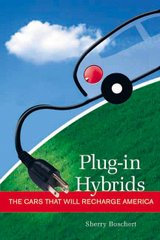
At EVS23 he stopped at the Plug In America booth to challenge what he felt was the overly optimistic tone taken by these advocates in their questioning at various sessions. One of the things he specifically said to Sherry Boschert, author of Plug-in Hybrids, to demonstrate the inadequacy of NiMH in electric cars was that the batteries have been replaced in many of SCE's fleet of RAV4-EVs. Chelsea Sexton of Plug In America inquired of Ed Kjaer at SCE to find out what the truth is. Here's what Mr. Kjaer wrote in response to the inquiry:
How he [Anderman] arrives at this fanciful assertion is frankly mystifying to us.

Were he to actually ask we would tell him that the majority of our EV fleet has consisted of '98 and '99 MY RAV4 vehicles. Of the almost 14,000 NiMH battery modules powering these EVs only a little less than 0.5% had to be replaced!

A powerful testament to Toyota and Panasonic design, quality, durability and reliability. And what is even more impressive is the fact that these vehicles were from the 1990's.

Hopefully this answers Sherry's question...for the record!
Getting a government contract to express one's informed opinion about batteries is one thing. That Mr Anderman always find them wanting despite evidence to the contrary is, perhaps, his right. But spreading malicious falsehoods without asking for evidence from those in the know suggests a lack of professionalism that ought raise questions about his analysis and methodology. It's past time for CARB and other agencies to broaden their search for objective consultants to analyze the state of battery technology.

Tuesday, December 11, 2007

Slate's EV Acid Test: Are electric cars greener?

Every electric car advocate is asked the same question every day: Are EVs really cleaner, greener, better for the environment? The long tailpipe, and all that. Slate, the online magazine, has an enviro Q&A column, The Green Lantern, that asks the question today.
Driving one still has an environmental cost, mostly associated with the use of Santa's most feared stocking-stuffer: 49.7 percent of our nation's electricity is generated by the burning of coal. But if you break down the numbers, EVs still come out ahead of cars featuring internal combustion engines, especially in terms of carbon dioxide emissions.
...The real question, then, isn't whether EVs are environmentally superior to today's gas-powered cars, but how they stack up against another technological rival: plug-in hybrids. The Lantern promises to tackle that question soon.

EV1 Stirs Emotions Decade Later

An emotional Alexandra Paul, actress who appeared in Who Killed the Electric Car?, is interviewed by Matt Kelley of Next Gear in front of an EV1 that made an appearance at RenewableLa put on by by Energy Efficiency Solar.

I gather GM really did destroy the molds and sever relationships with suppliers, but it is so clear that if they simply re-released the EV1 today it would still be a show stopper. Who thinks that GM couldn't sell 5-10,000 EV1s for between $50,000 and $75,000? And wouldn't those cars, even if they took a loss on each one, bring more positive results for GM than the millions of dollars of "Gas-Friendly to Gas-Free" adverts endlessly appearing in the American media these days?

German Battery, German Electric Car?

An Agence France Presse report has produced a small flurry of articles this past week, here and here, for example, that has a German company developing Lithium batteries that would be suitable for electric cars. Li-tec is said to be working in cooperation with Bosch and Volkswagen, which has heightened interest.

One can only hope, despite scant evidence, that the fierce grip of internal combustion on the German automakers might loosen. German Greens have bought into hydrogen hype as much as California regulators. BMW is pushing hydrogen gas into the most complicated engine ever and dousing the American airwaves and celebrities with this unavailable $500,000 diversion.

The country has admirably pushed renewable electricity generation, offering subsidies and incentives greater than most any other nation. Their insatiable appetite for solar panels has kept the world price high and supply low. But somehow, the increasingly low-carbon grid has not enticed either automakers to manufacture or policy makers to create incentives for grid connected cars. Do the Germans actually intend to make a green grid, only to throw away 75% of the energy to the losses involved in hydrogen production?

Of late, the French, Irish and Finns are creating feebate structures that could push electric cars. The Norwegians have a host of EV positive initiatives. But the Germans, for all their green reputation, remain laggards. The German government has opposed the strictest CO2 emission proposals in the EU, in order to protect their domestic, comparatively more polluting, auto industry.

Perhaps a German battery will propel interest. An electric VW, say a Plug-in UP!, might bring boomers back to the car that brought them to their first Earth Day rally.

Monday, December 10, 2007

Th!nk City: Electric Civic for the 21st century?

Business 2.0's Green Wombat blogger Todd Woody has written up an optimistic report on the Th!nk City titled A Honda Civic for the age of global warming. As I mentioned a week or so ago, the first new Th!nk City electric car has rolled off its Norwegian assemblyline. Everything in the piece agrees with our previous understanding - Zebra batteries for now, EnerDel and A123 Lithium in the future; battery leasing in Norway; US release a number of years away at best. Biggest piece of news:
According to [CEO Jan Olaf] Willums, General Electric (GE) is now an investor in Think and the company struck a deal with GE to collaborate on battery technology.
Perhaps Andy Grove already had an inkling when he penned his incitement, as mentioned here, to "Think Disruptive." It wouldn't be the first time GE has dabbled in electric cars.

Friday, December 7, 2007

French CO2 Feebate Plan Good News for Electric Cars

The French government's Ministry of Ecology has instituted a CO2 based "feebate" scheme. Low emission vehicles will receive a rebate, high emission cars will be assessed a fee. Mid level emitters, representing about 45% of the cars currently sold, will be unaffected. As reported on the Green Car Congress website, electric vehicles would receive 5 times the rebate available to the best currently conceivable ICE vehicle. A Smart Car emitting less than 100 grams of CO2 per km would receive a €1000 ($1466) rebate. An electric car would receive €5000 (over $7300.)

French automakers probably have put more electrics on the road than all others combined, although they were limited to fleets. Hopefully this will spur Renault and Peugeot to offer consumers EVs.

Wednesday, December 5, 2007

EVS23: It's the Plug, Stupid

John Voelker has posted from EVS23 for IEEE's Spectrum, and he ain't writing about fuel cells. Except to point out that Honda's FCV rep actually got hissed as he dissed lithium batteries. The same lithium batteries without which Honda's much heralded Clarity who chug along like a quiet 1960s era VW bug.
The FCX Clarity will be leased for $600 a month, starting next summer, to selected customers in Southern California. “That means,” said one bystander, “that Honda’s picking up the other $600,000 on each vehicle.” Which is as good a way as any to summarize the cost challenges of fuel-cell vehicles—even before looking at the infrastructure challenges.

If one statement sums up this conference so far, it’s this one, overheard in the hallways: “It’s all about the plug-ins, stupid!”

Monday, December 3, 2007

Entourage Star Breaks Parking Law in BMW Hydrogen 7

It's a shame the video on TMZ.com doesn't include the reporter's voiceover, because the narration I heard when the story aired on TV caught the reality of hydrogen hype better than most serious enviro journalism. Automakers using movie stars to greenwash was its essence. The story, as reported on TMZ.com:
He's all for saving the environment, but Jeremy Piven also likes to break the law!

TMZ caught Piven in front of the Newsroom Cafe on Robertson with his new hydrogen-powered BMW yesterday, where the "Entourage" star asked us to tell the Governator to get more hydrogen stations. Sure, Ari!

It's great that he's going green -- but does that make him special enough to park in a red zone?!


A123 & LG Chem Battery Packs for Chevy Volt Unveiled at EVS23

GM-Volt.com is reporting on battery announcements at EVS23. Both A123 and LG Chem/Compact Power have delivered packs to GM for testing in the Volt. GM has announced plans for real world testing in vehicles in spring 2008, and with these batteries in hand, they appear to be meeting their announced timetable.

IEEE Tech Talk: Times They are a'Changin'

IEEE Tech Talk's John Voelker's report is titled EVS-23: A Surge of Energy for Electric Cars. It is a first comment on the palpable difference being experienced at this year's Electric Vehicle Symposium (EVS23), the electric drive industry trade show. An astounding 450 people attended Sunday's plug-in hybrid workshop. A member of congress, for the first time, spoke from the floor about promoting electric vehicles through federal legislation. Five major automakers have expensive displays. Voelker writes:
A year ago, the Chevrolet Volt was unknown......The demand for plug-in hybrids has exploded.....grumbled the City of Vancouver’s Brian Beck, “I’m ready to change the building code to require electric plugs throughout parking garages, but automakers tell me I can’t get their plug-in prototypes...
Still no plug-in hybrids or electric cars in showrooms, but things are looking up.

Thursday, November 29, 2007

First New Th!nk City Rolls Off Line

Good news from Norway. Automotive News (subscription required) reports:
Think Global has launched production of an electric minicar for European markets. On Wednesday, the first City minicar rolled off the assembly line at Think’s plant in Aurskog, northeast of Oslo. “This project is on time. We are building full production cars with all the right components from the right suppliers,” Think Global CEO Jan-Olaf Willums said.
In the wake of Tesla's decision not to sell it's batteries, word is the first cars will be using the Zebra battery.

Saturday, November 24, 2007

Fahrvegnügen and fuhgedaboutit: V-Dub Disses Hybrids, Hydrogen & CO2 Concern

Edmunds Inside Line's Alistair Weaver interviewed Wolfgang Hatz, the head of powertrain for the entire Volkswagen Group. The title of their piece, Mr Engine Fuels the Future, probably tells you all you need to know. Quotations from the interview below; first, my somewhat snarky synopsis.

Hatz, in short: Hybrids are bogus - "a very expensive way to save a small amount of fuel." But because Americans have fallen for the idea, the politically expedient thing for VW to do is make some hybrids. Hybrids' PR payoff is bigger than their environmental benefit. Everyone's paying too much attention to global warming anyway. Low carbon cars don't make the air cleaner. Diesel is more efficient than gas, it just needs good filters. Gas and diesel are here for three more decades at least. Hydrogen makes no sense due to its inefficiency, certainly for the next 30 years. And he wasn't asked about batteries or plug-in hybrids or electric cars.

Fahrvegnügen and fuhgedaboutit.
Will hybrid become the dominant power source in the next few years?
Hybrid technology is a very expensive way to save a small amount of fuel. The cost/benefit analysis is quite on the expensive side, but we're politically pressed to develop hybrids by the U.S. market.

If someone said that every car must be a hybrid, the car industry would be bankrupt quicker than anything else. Even Toyota would have problems if they had to produce hybrids in high volumes. But politically we have to do a certain amount of hybrids.

What about diesel hybrids?
For fuel economy, this is the best option, but it's a very expensive solution.

Is there too much emphasis on carbon-dioxide (CO2) emissions?
There is too much emphasis. Politically, it's very popular to say that you're going to ban cars that emit over 225g/km of carbon dioxide in London, but it won't make any difference to the ambient atmosphere. It's more important to make sure that all cars are fitted with particulate filters than to reduce the CO2.

Is hydrogen power the best long-term fuel solution?
Hydrogen only makes sense if it's produced from a regenerative source. If you produce it from electrolysis, the efficiency is just 50 percent. We don't know how to produce or transport it efficiently, which means that it's better to use regenerative energy for other things. I don't think it will be an alternative in the next 30 years. It doesn't make sense.

Gas and diesel will still be around in 30 years' time. Both will survive because we need to extract both the heavy and the light fuels to achieve the maximum efficiency from our oil. We have to use our energy in the best way.

Thursday, November 22, 2007

London Calling: Congestion Charge Recharges Electric Cars

London could soon replace California as the electric car capital of the world. Thanks in large part to Mayor "Red Ken" Livingstone, who enacted London's much criticized congestion charge policy in 2003.

The policy, which exempts electric cars from hefty daily taxation, is resulting in increasingly significant vehicle choices for English consumers. India's Reva was first into the market with the G-Wiz. The French Mega City appeared next from NICE (No Internal Combustion Engine). Sakura Battery Co is offering a line of EVs, including the Italian Maranello4 microcar. Despite being low-speed vehicles about which safety concerns have been raised, they have months long waiting lists. Limited ranged, lead-acid battery based cars, they have nonetheless proven the demand of even less than perfect electric vehicles.

Norway's Th!nk Global views London as a first market when it relaunches the Th!nk City in 2008. ZAP, maker of the 3 wheeled Xebra, "has passed Vehicle and Operator Services Agency (VOSA) inspection, allowing it to be driven on roads in the United Kingdom," according to recent news reports. Its UK marketing plans are, however, unknown. And Tata Motors, an Indian industrial giant, is "working on an electric version of the Indica for the overseas market, slated to be launched by 2009," according to the Hindu Business Line.

To facilitate these EVs, Charging stations are being put in place by local councils, making even short range electric cars viable for commuters.

And now major automakers appear almost ready to get in on the action. Daimler is set to be the first on the street with 100 test vehicle SMARTs in 2008. Mitsubishi could be the first with cars for sale if the UK distributor has its way.

Daimler Smart ForTwo electric trials are set to begin in London, according to the Financial Times. Corporate and public-sector fleets will get to lease 100 test cars for a pilot period of four years. Yet Daimler's intention is more ambitious.
If the tests turn out as Daimler hopes, the company plans to begin commercial production in 2010, before the end of the pilot. “We want to test it and get it into production,” Mr [Anders] Jensen, head of the Smart brand team, told the Financial Times on Wednesday......The brand chose London for the pilot in part because of its network of free public recharging stations.
The first cars will utilize NiMH batteries, as do the Toyota test platform Plug-in Priuses at the University of California. From where I sit (in the driver's seat of a NiMH powered Toyota RAV4 EV) this seems eminently practical. Sacrificing some of the energy density and range in Lithium for the robust proven long-life and reliability of Nickel batteries makes tremendous sense. Hopefully GM's and others' gamble on Lithium in the first rendition of their new EVs will prove correct, but getting trouble free cars on the road quickly is what we need. NiMH is the risk-free pathway.

Mitsubishi's i-MIEV, an electric city car (using Lithium) about which much has been written (see EVWorlds report from Tokyo,) is meant to go into production in Japan for Japan in 2009. According to Autocar.co.uk, "the firm’s British importer is currently lobbying hard to add the car to its UK product portfolio as early as possible." The i-MIEV would make available for the first time in the UK a full-function, highway-capable electric car, if still very small by American standards. It is projected to cost between £15,000 and £20,000, a pricey $30-40,000 at today's weak dollar. Still I suspect there would be greater demand than initial supply. There is a market for cool and clean at the low and high end.

G-Wiz (depending on model)
Cost: £6600 - £8900 ($13,600 - $18,400)
Range: 40-48 miles
Top speed: 40-50 mph

MEGA City
Cost: £10,500 - £11,000 ($21,600 - $22,700)
Range: 40miles
Top speed: 40 mph

Smart ForTwo:
Cost: unknown
Range: 110km (68miles)
Top speed: 115km/h (71.5mph)

Mitsubishi i-MIEV
Cost: £15,000 - £20,000 ($30,000 - $40,000)
Range: 160km (100 miles)
Top speed: 130km/h (80 mph)

Wednesday, November 21, 2007

Oil Flirts Again with $100 a Barrel

NY Times late Wednesday:
Oil prices flirted with the symbolic $100-a-barrel level in overnight trading.
Crude oil futures briefly rose above $99 in overnight trading and an Energy Department report showed that inventories fell slightly last week, leaving investors wondering how soon oil will be nudged above its inflation-adjusted record of $102. Crude settled in New York trading at $97.29, down 74 cents.

Andy Grove Advocates Disruption

In the Wall Street Journal Online, The Informed Reader, Andy Grove, onetime CEO of Intel, discusses corporate "cross-boundary disruption," such as Apple moving into the music business.
As a suggestion, Mr. Grove says General Electric Co. could benefit from a cross-boundary disruption by building an electric car. Neither auto makers nor energy companies seem willing to exploit new energy sources or reduce the U.S.’s dependence on foreign oil. GE has the money and expertise to build both an electric car and the machinery needed to charge it. — Robin Morone

Tuesday, November 20, 2007

GM's Bob Lutz Queried

US News and World Report interviews GM's Bob Lutz.

So of all the different technologies GM is working on, how would you prioritize them?

Electric. Advanced hybrid. Plug-in hybrid. Advanced clean diesels. And far out, there's hydrogen.

Monday, November 19, 2007

LA Times Op-Ed Poses Real Choice Facing California

The op-ed in today's LA Times (We Need Voltswagens in the print edition; Bring back the electric car online) deserves attention from the public and state policy makers. Sherry Boschert, author of Plug-in Hybrids, is publicly posing the stark question as it needs to be asked: Will CARB push for cars capable of zero-emission driving for today's consumers using available, affordable, tested battery technology or will they support mere research programs even proponents say won't be marketable for a generation.

On the ground at the LA Auto Show, and on the air (Honda here and BMW here) automakers tout hydrogen & fuel cell vehicles disingenuously as "ready for the world when the world is ready." Behind the scenes they lobby to lower the numbers of these million dollar babies they must produce to meet their zero emission vehicle obligations. As Martin Zimmerman of the LA Times recently wrote in an otherwise gushing review of the Toyota FCHV recently, "Maybe, as some critics like to say, hydrogen is the fuel of the future and always will be."

It's past time the public, environmental organizations and policy makers got hip to the automaker con game and all got on the same page advocating plug-in cars. I look forward to CARB's response.

Friday, November 16, 2007

Th!nk on the Move

Aftenposten TV news clip of the new Th!nk City here including shots of the assembly line and interview with CEO Jan Olaf Willums. The report mentions a price for the car and monthly charge for the battery, but more than that I couldn't comprehend. How's your Norwegian?