For years we've been hearing there's a chicken/egg situation with EVs. Consumers, it's often suggested, have rejected plug-in cars because there is no charging infrastructure. No, I've always said, we have a chicken problem. No plug-in cars. The infrastructure, ubiquitous electricity, exists. Monday, March 7, 2011
PlugShare creates guerilla network to charge electric cars
For years we've been hearing there's a chicken/egg situation with EVs. Consumers, it's often suggested, have rejected plug-in cars because there is no charging infrastructure. No, I've always said, we have a chicken problem. No plug-in cars. The infrastructure, ubiquitous electricity, exists. Thursday, March 3, 2011
The trials of public charging, part 2 (of many to come)

Near-term monetization also threatens needed expansion of charging infrastructure, as the early installations become underutilized. It is already ironic enough that the two companies pushing monetization as the necessary component for a successful rollout of public charging infrastructure have taken the lion’s share of the public funding in order to develop their “free market” solution. It would be doubly ironic if low usage caused by early monetization resulted in insignificant amounts of revenue suggesting a poorer profitability picture than projected creating an impediment to necessary further expansion of both public charging stations and their own business.
The federal funding should have come with strings attached. For a certain period, say two to five years, the electricity should just flow. No connecting to a network, no payment. The host - the city parking garage or shopping mall - would agree to cover the cost of electricity in exchange for the charging unit and all the green cred and good will they can muster. After a few years, with lots of experience, let the hosts decide if they want to monetize. At that point hopefully there will be enough plug-in cars around that they will no longer be a novelty needing explaining, and we will actually want to discourage purely opportunistic public charging to ensure their availability when someone really needs the juice. At that point, we'll all be willing to pay.
But if PlugShare catches on, we may not have to.
"Transmission" Losses: Billion Dollar Fuel Theft
After nearly a decade of mismanagement, theft and fraud, the U.S. military still hasn't found a way to staunch the flow of what is likely hundreds of millions -- if not billions -- of dollars in lost fuel in Afghanistan, some of which is sold on the black market and winds up in Taliban hands, a TPM investigation has found.
[Source: TalkingPointsMemo.com]
Saturday, February 26, 2011
The electricity in gasoline
Thursday, February 3, 2011
iMiev #1 in Norway
[Source: Electricaid]
Wednesday, January 26, 2011
"When money flows from the ocean floor"
It's about time. If there's one country that ought to have long ago developed a domestic electric car industry it is Israel. No oil of its own should be reason enough. Every drop purchased on the international markets propping up its sworn enemies should be reason enough. Not very far to drive in this very small country should be reason enough. Lots of high tech brainpower should be reason enough. Dayenu.The beginnings of Better Place, of course. Also, one could hope, the beginning of the transformation of Israel from a vulnerable fossil-fuel deficient and dependent nation into a 21st century renewable energy beacon.
Now it seems the discovery of natural gas off the coast may have moved Israel's eye off the prize.
"The beautiful vision evaporated in the bureaucratic grinders, and the prime minister fell into the very trap against which he had warned. When money flows from the ocean floor, who has time to think about correcting the world?"Read the interesting tale here.
[Source: Ha'aretz]
Obama rolls out EV strategy
[Source: Detroit News]
Thursday, January 20, 2011
Mercedes Pleads for More Handouts for Hydrogen
[Source: AutoBlogGreen]
Monday, January 3, 2011
Tuesday, December 28, 2010
EV Ownership Shortcut?
Here's an unexpected opportunity to purchase an EV, especially if you've had a hankering for a Th!nk City.According to the Seattle Clean Cities Newsletter, you've got three days to order a Th!nk City for $6000 off from the base price of $41,695 if you live in a ZEV state. Th!nk is apparently looking to quickly sell 150 of the vehicles they are putting together in Elkhart, IN. Offer ends December 31.
Add in the federal tax credit, and the electric two-seater is down to around $28,000. If they can deliver quickly enough to California, a rebate of $4000 - 5000 should kick in as well.
That's obviously less car for about the price of a Nissan LEAF. But if you haven't ordered one yet, there could be quite a wait.
Wednesday, December 22, 2010
Proud Papa
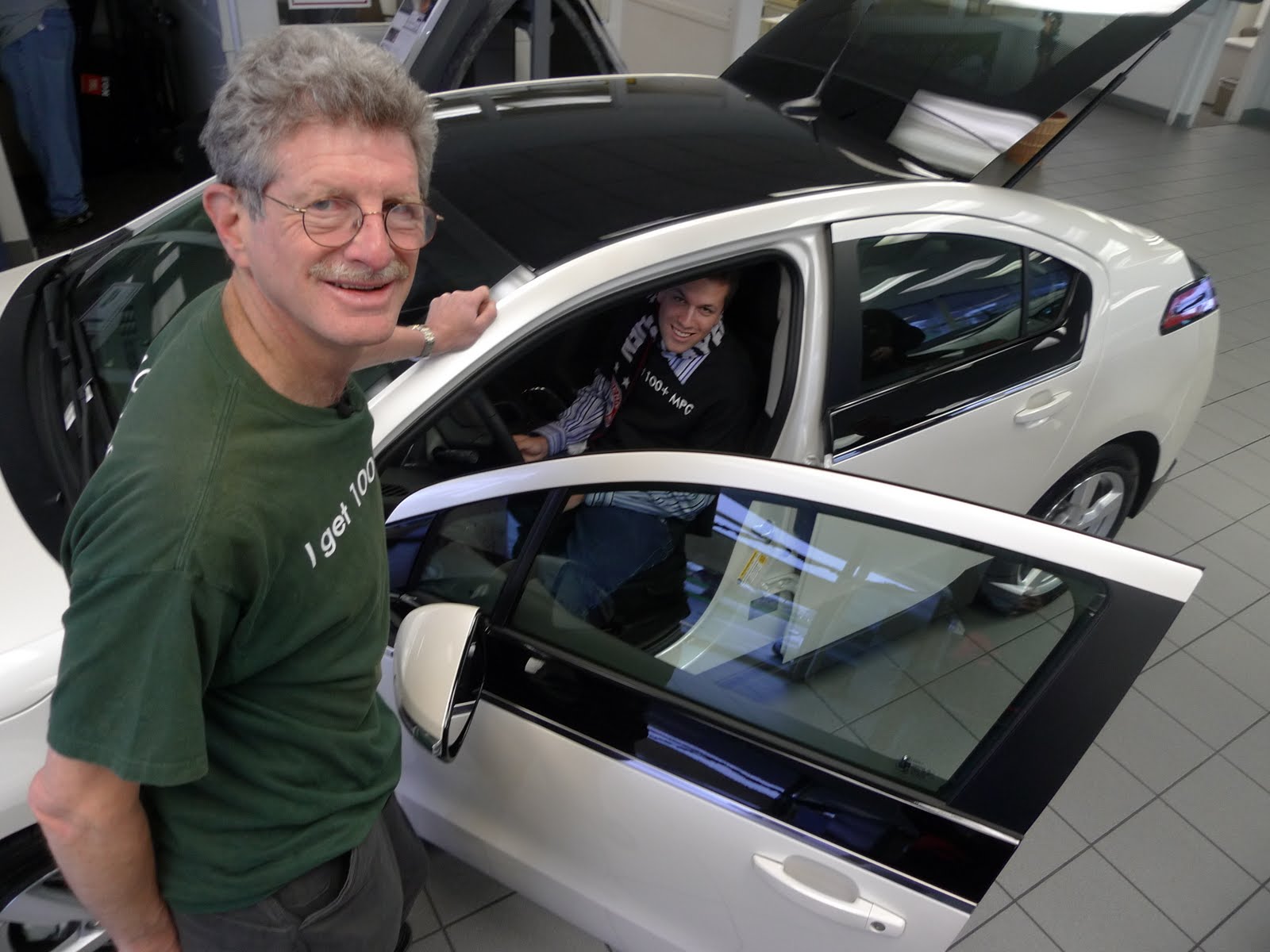
Andy Frank, father of the plug-in hybrid, drove down from Davis, California in the Volt he received yesterday to join in the celebration.
Wednesday, December 15, 2010
My Trial LEAF & the trials of public charging
I've got a LEAF for a few days. Very exciting. I'll have a full report soon. But I've got to mention one frustration I've encountered. Restricted charge stations.
In San Francisco at this moment there are, I believe, six deployed new J1772 charge stations. One, a ParkPod unit in the Hilton parking lot, was installed with private funds. Two are at a private parking garage on the Embarcadero, paid for with federal and state money via Coulomb's ChargePointAmerica grants. And three streetside at City Hall, trumpeted in signage as a "Green Vehicle Showcase."
Usage at the City Hall location is restricted; only official city and ZipCar plug-in vehicles may use them. All others subject to ticketing and towing.
Ironically, in practice this means only the converted plug-in Priuses in government and ZipCar fleets, using the 120 Volt receptacle in these Coulomb ChargePoint stations, can park and charge. The LEAF I've got for a few days, which could plug in at Level 2 and be showcased, remains underground out of site while I sit on a jury a block away. And I could use the charge, as I'm charging at 120 volts at home. And, adding insult to injury, two of the three spaces with chargepoints were open when I went to court, during lunch, and when I departed. The third, occupied by a BAAQMD plug-in Prius, appears not to have gone anywhere, long ago charged to full.
The point isn't my convenience while doing jury duty. Ordinarily, I'd take the bus. It's about optimally utilizing the public investment in charging infrastructure. San Francisco spent tens of thousands of dollars installing these charge stations. Mayor Newsom trumpeted their arrival, and Coulomb uses them in its self-promotion. They are serving everyone's interest save the public.
The day has finally arrived when they could be used as intended, for opportunity charging and to showcase the arrival of electric vehicles. Bureaucratic obstacles must be overcome, at least during the first year or two, to maximize the public benefit of this investment. Empty spots and/or restricted access does not serve the interest of the drivers, nor in reality, of the infrastructure providers or government trying to educate the public about electric vehicles.
Saturday, December 11, 2010
First LEAF delivered in Petaluma California
Check out Nick Chambers' report in plugincars.com
Wednesday, December 8, 2010
Help Plug In America renew the EV infrastructure tax credit
Last year, Plug In America, along with electric vehicle and EV infrastructure manufacturers from coast to coast, worked with members of the House and Senate to get a critical plug-in vehicle infrastructure tax credit into the stimulus bill.
And then you helped us get it passed!
These EV tax credits of 50% up to $2,000 for individuals, and 50% up to $50,000 for businesses have led to the beginning of early deployment of EV charging infrastructure all across the United States.
But the infrastructure tax credit is set to expire on 12/31/2010 unless we act now!
Just as plug-in cars are about to get on the road is absolutely the wrong time to end these tax credits.
We were initially successful in advocating for an extension in the proposed 2010 tax extenders legislation. But now our efforts are threatened - we hear that the tax credit extension for EV infrastructure may be scaled back or eliminated from the tax extenders bill. This credit should be extended at the same level as in the stimulus for at least another three years.
We need your help - and we will do most of the work. Please take just a moment to click through the link below and send a strong message to your representatives in Congress and the President telling them that you want plug-in electric vehicles to be successful along with the truly green jobs they can create. Show Washington just how serious you are about wanting to make sure we can get affordable plug-in infrastructure at our homes and businesses and support plug-in vehicles getting on the road now.
It is time to ask Congress to advance the next generation of transportation options. Each and every voice they hear will make a difference.
Let us do the work for you - Just click the link below and in less than a minute you can get your message to Congress about this key issue:
Click here to tell Congress you want these tax credits extended
Thank you!
Jay Friedland
Legislative Director
Plug In America
P.S. If you are about to purchase a new plug-in vehicle, you may want to purchase your EV charging station before the end of the year just in case!
Tuesday, November 30, 2010
Wednesday, November 24, 2010
Ethanol Gets Teabagged
UPDATE: California Senator Dianne Feinstein is on board will letting the subsidies expire on December 31, 2010.
[Source: Washington Post]
Wednesday, November 17, 2010
Coulomb, MasterCard, and the future of public charging
Mayor Newsom and many city employees were there, along with large signs and representatives
The big takeaway: If you want a free charge station and are located in a program area (Austin, Los Angeles, New York, Orlando, Sacramento, San Jose/San Francisco Bay Area, Bellevue/Redmond, Washington DC, Southern Michigan), raise your hand now. ChargePoint America is looking for hosts for charge stations.
If you are a consumer, and you get a Volt, Smart, or Ford electric car, you probably qualify for a free home charge station. (Nissan LEAF buyers are excluded. Ecotality's EV Project got an exclusive.)
If you are a business in a program area, you can get the same deal - free charge stations paid for by stimulus money. And if you're located in California, the California Energy Commission portion of the grant to Coulomb will pay for installation.
As Richard Lowenthal said to me at the event: "Great deal!" Certainly. But for whom?
I want to see adequate public charging infrastructure installed in sensible locations. I think it makes sense for public resources to drive the early rollout. Time will tell what business model/s might work to provide an adequate supply and dispersal of public charge stations. But given the relatively low cost of electricity, and the large public environmental benefit, it seems premature to presume monetization or let the desire for monetization drive the placement of charge stations.
Where should publicly funded infrastructure be located, and who should decide? Is it good public policy to encourage businesses to acquire free charge stations at public expense without any commitment other than putting them in service? Should 100% of the cost be born by taxpayers if 100% of the benefit goes to private business? Should a model of host-supplied electricity (like host supplied parking or wi-fi) be given an equal chance to succeed?
In the past, in exchange for California's financial support for public charge station installation, the business hosting the charge station covered the cost of the electricity, the smallest part of the equation. EV drivers thus have simple access to electricity, allowing them to use their zero-emission vehicle to the max. The business hosting the charge stations get some "green" cred, along with hopes of attracting customers with EVs. That seems to me a fair deal between taxpayers and business, and a better way to promote the use of electric vehicles.
To be fair, Coulomb itself is officially agnostic regarding whether a station's host will charge for the electrons, but the deal with MasterCard suggests the direction they're heading.
And Coulomb is not alone. Ecototality, the other big beneficiary of public largesse (again in the tens of millions of dollars,) has made clear that its EV Project public charge stations will require payment by next May.
Some companies are pursuing a different model, selling charge stations that aren't part of a proprietary network and that don't presume to be monetized. As far as I know, Clipper Creek,
Leviton, AeroVironment and GE, for example, will be selling equipment but will not attempt to collect ongoing revenue from the delivery of electrons. Free Juice Bar explicitly sells charge stations to offer free power.The question isn't whether drivers of plug-in cars deserve free power. Obviously not.
The only important question is what will help drive rapid adoption of plug-in vehicles. Will a monetized public charging infrastructure from the get-go promote plug-ins? Or, in fact, could we soon find monetized charge stations remain underutilized given a cost at least twice that of home charging. Resulting in empty, restricted parking spaces sparking general resentment rather than the recognition and perhaps envy we hope to engender.
The new ChargePoint America installation seems designed to illustrate my point. Why, given what we know about charge station placement, are the two Priority Parking charge stations in the most prominent, desirable spots, right at the entrance. Virtually everyone who enters this parking lot for the foreseeable future will likely pass two empty spots, reserved for apparently non-existent electric vehicles.
Public charge stations are best located where hosts have motivations greater than some small financial benefit. Businesses are looking to attract customers and show their green side, and government is seeking the emissions reduction benefit of plug-ins.
Public dollars should be used in a manner that best promotes plug-in electric vehicles and maximizes the environmental benefit in the near term. Creating an new industry that converts cheap electricity into a monetized charge session is not necessarily the best way forward.
Sunday, November 14, 2010
BP Israel awaits first 13 Fluences
[Source: TheGreenCarWebsite.co.uk]
Wednesday, November 10, 2010
Saturday, November 6, 2010
Czinger Zinger: CODA CEO resigns
Just three days after Michael Jackson, Coda Automotive's senior vice president of global sales, marketing and distribution, resigned to start his own company, the company's CEO, Kevin Czinger, is also stepping down from his position. Czinger, who has pretty much been the public face of the Miles Electric Vehicles spin-off since he joined in 2008 – and a substantial shareholder – will adopt the role of senior strategic advisor.[Source: AutoBlogGreen]